
Sales Funnel vs Sales Pipeline: Key Differences 2026
Quick Answer
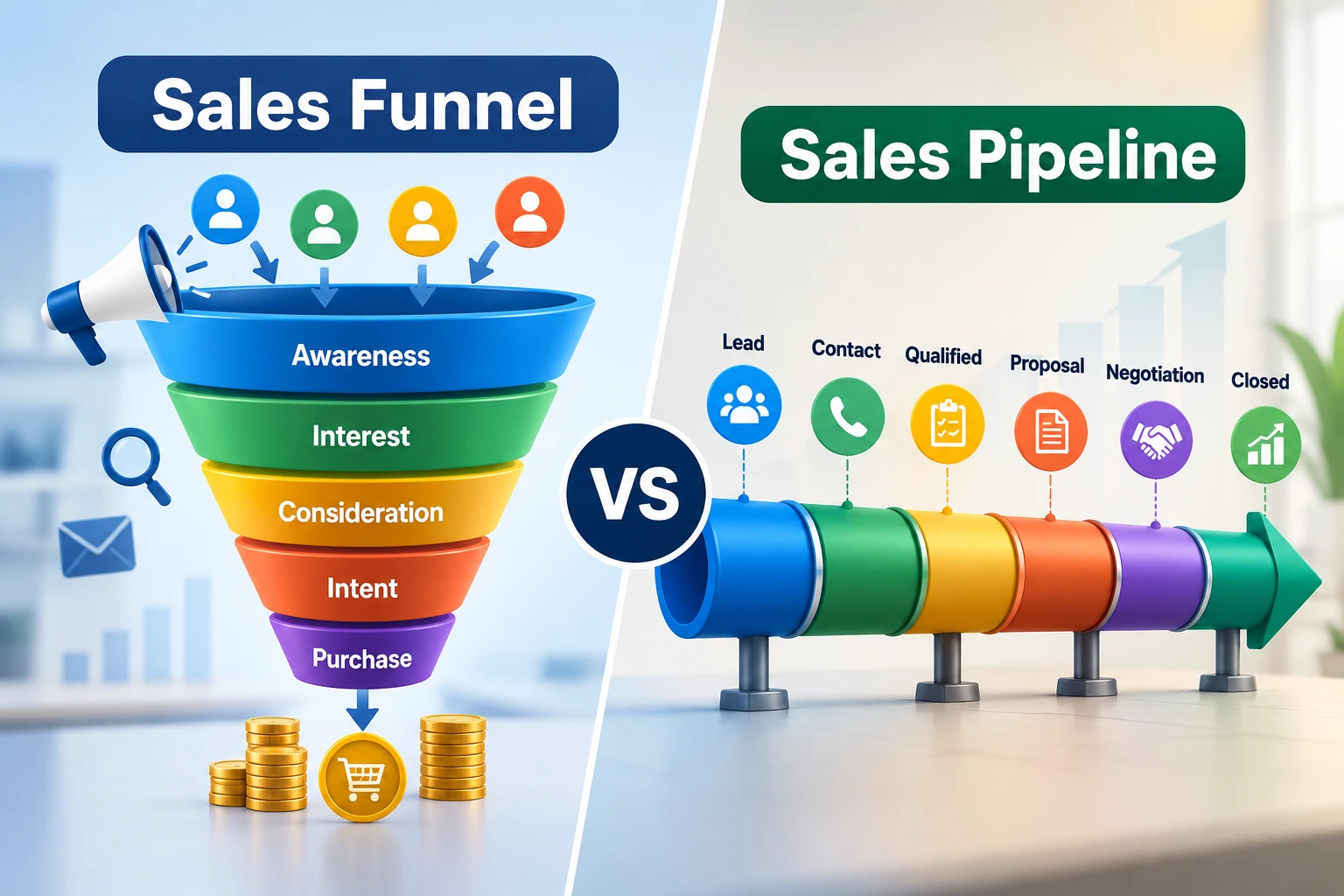
A sales funnel tracks how groups of potential customers move from awareness toward purchase, while a sales pipeline tracks individual sales opportunities as your team works them toward closing. In simple terms, the funnel is mainly buyer-focused and conversion-focused; the pipeline is seller-focused and deal-management-focused. If you’re still building the customer journey, start with a sales funnel strategy.
Key Differences at a Glance
- Perspective: Funnels show the buyer journey; pipelines show the seller’s active deal process.
- Main focus: Funnels measure conversion and drop-off; pipelines measure deal progress and sales activity.
- Unit tracked: Funnels usually analyze groups of leads; pipelines track individual opportunities.
- Primary users: Marketing teams rely heavily on funnels, while sales teams work mainly from pipelines.
- Best approach: Most growing businesses should use both instead of choosing one.
Sales funnel and sales pipeline sound like two names for the same thing. I used to see them that way too.
The difference becomes obvious once you start tracking real leads. One model tells you how people convert, while the other tells you what your sales team should do next.
In this guide, I’ll break down sales funnel vs sales pipeline, their stages, metrics, examples, and when you should use each one.
What Is a Sales Funnel?
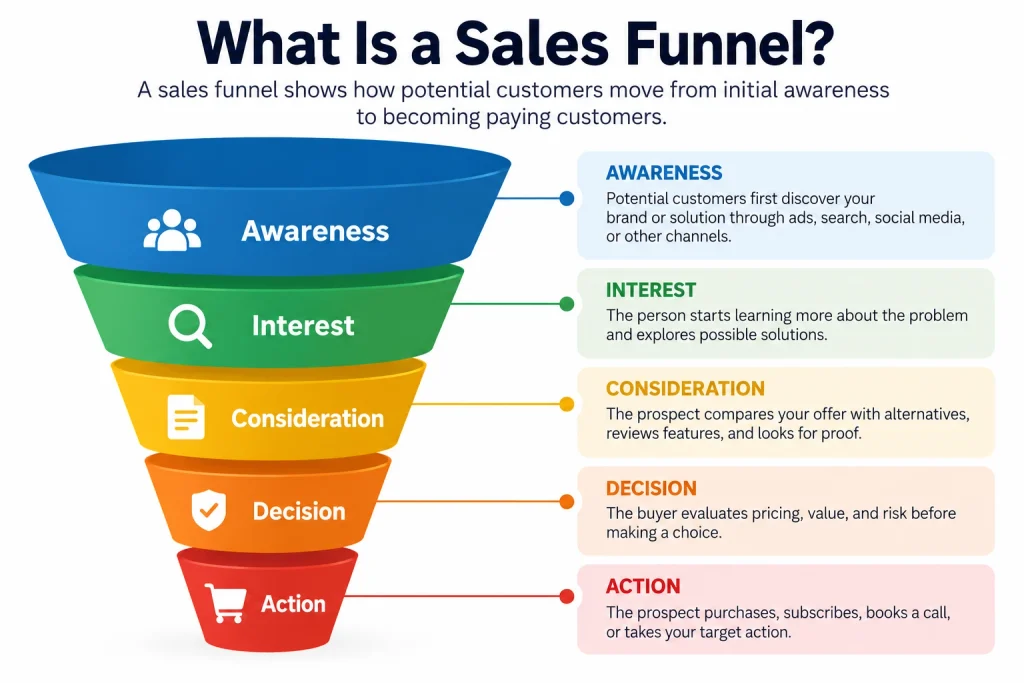
A sales funnel is a model of how potential customers move from initial awareness toward becoming customers. It gets its name from the way the number of prospects usually narrows as people move closer to purchase.
Many people may discover your business, but only some become leads. An even smaller percentage eventually buy.
- Awareness: A potential customer first discovers your brand or solution.
- Interest: The person starts researching the problem and possible solutions.
- Consideration: The prospect compares your offer with alternatives.
- Decision: The buyer evaluates pricing, features, proof, and risk.
- Action: The prospect purchases, books, subscribes, or takes your target action.
The exact stages aren’t universal. Your funnel should reflect how your customers really buy.
For example, a $20 digital product may need only a landing page and checkout. A high-ticket consulting offer may require content, a lead form, qualification, calls, and follow-up.
If you’re building the digital side of this process, my GoHighLevel funnel builder guide explains how pages, forms, CRM data, and automation can connect.
What Is a Sales Pipeline?
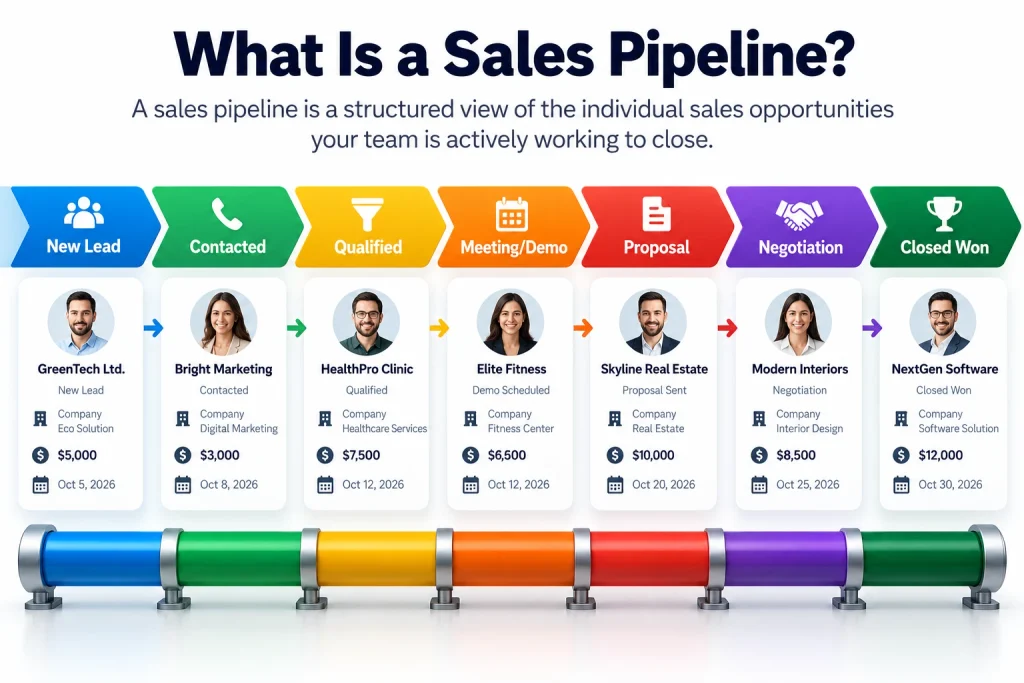
A sales pipeline is a structured view of the individual sales opportunities your team is actively working. Each opportunity sits in a stage based on what has happened and what should happen next.
Instead of asking, “How many visitors become customers?” a pipeline asks, “What is happening with this specific deal?”
- New lead: A potential opportunity enters your CRM.
- Contacted: A salesperson starts a conversation.
- Qualified: The lead matches your basic buying criteria.
- Meeting or demo: The team presents the solution or explores the buyer’s needs.
- Proposal: Pricing, scope, or an offer is sent.
- Negotiation: The buyer and seller work through objections or terms.
- Closed won/lost: The opportunity ends with a purchase or no sale.
A useful pipeline also shows deal value, owner, expected close date, activity history, and next action.
That’s what makes pipelines especially useful for sales management and forecasting.
Sales Funnel vs Sales Pipeline: What’s the Main Difference?
The biggest difference is perspective. A sales funnel analyzes how buyers move through the buying journey, while a sales pipeline manages how sellers move individual opportunities through the sales process.
Here’s the side-by-side view I use when explaining the difference.
| Comparison | Sales Funnel | Sales Pipeline |
|---|---|---|
| Primary perspective | Buyer journey | Seller activity |
| Tracks | Groups of prospects and conversion | Individual opportunities and deal status |
| Main goal | Improve conversion between stages | Move deals toward closing |
| Typical owner | Marketing and growth teams | Sales teams and managers |
| Common metrics | Conversion rate, drop-off, cost per lead | Pipeline value, win rate, deal age |
| Typical visualization | Wide top narrowing toward purchase | Stage-by-stage columns or CRM board |
| Key question | Where are prospects dropping out? | What should happen next with this deal? |
Salesforce similarly describes the funnel from the customer’s point of view and the pipeline as the seller’s view of opportunities. You can explore its broader explanation on the Salesforce sales resource center.
How Does a Sales Funnel Work?
A funnel works by measuring how many people enter one stage and how many continue to the next. That makes conversion and drop-off visible.
Imagine 10,000 people see a campaign during one month.
- 10,000 people see the offer.
- 1,000 visit the landing page.
- 250 become leads.
- 75 become qualified opportunities.
- 20 become customers.
The funnel helps you identify where the biggest loss happens. You can then focus your optimization work on that stage.
For example, strong traffic with few leads may point to a weak landing page or offer. Plenty of leads with few sales may indicate poor qualification, follow-up, positioning, or sales execution.
How Does a Sales Pipeline Work?
A pipeline gives each active opportunity a current stage and next action. Sales representatives update the opportunity as the deal progresses.
Suppose an agency has three active opportunities worth $2,000, $5,000, and $10,000.
- Deal A: $2,000 and waiting for a discovery call.
- Deal B: $5,000 with a proposal already sent.
- Deal C: $10,000 currently in negotiation.
The pipeline doesn’t simply show how many leads exist. It tells the team where revenue opportunities stand and which ones need attention.
CRM platforms make this easier because contacts, conversations, opportunities, and stages can live together. My GoHighLevel CRM guide shows a practical example of building a simple opportunity pipeline.
Do Sales Funnels and Sales Pipelines Use the Same Stages?
Not necessarily. Some stage names may overlap, but each system should measure different parts of the revenue process.
Your funnel might use awareness, lead, qualified lead, opportunity, and customer.
Your pipeline could use new opportunity, contacted, discovery scheduled, proposal sent, negotiation, closed won, and closed lost.
- Funnel stage: Describes where a buyer sits in the broader conversion journey.
- Pipeline stage: Describes the status of a specific opportunity and the sales work required.
Trying to force identical stages into both models can make reporting harder instead of easier.
Which Sales Funnel Metrics Should You Track?
The best funnel metrics show how efficiently prospects move toward conversion. I wouldn’t fill a dashboard with dozens of numbers at the beginning.
I would start with a small set that answers useful questions.
- Visitor-to-lead conversion rate: Shows how well traffic becomes identifiable leads.
- Lead-to-opportunity rate: Measures how many leads become genuine sales opportunities.
- Opportunity-to-customer rate: Shows how effectively qualified opportunities become customers.
- Stage drop-off: Reveals where the greatest percentage of prospects disappear.
- Customer acquisition cost: Helps compare what you’re spending against customers acquired.
These metrics tell you where the funnel needs attention. They don’t tell a salesperson what to do with an individual deal.
Which Sales Pipeline Metrics Should You Track?
Pipeline metrics focus more heavily on deal quality, movement, timing, and expected revenue.
- Total pipeline value: The combined potential value of open opportunities.
- Win rate: The percentage of qualified opportunities that become closed-won deals.
- Average deal size: The typical value of a successful sale.
- Sales cycle length: The time required to move an opportunity from entry to close.
- Deal age: How long an opportunity has remained open or stuck in one stage.
- Pipeline velocity: How quickly potential revenue moves through your process.
HubSpot describes pipeline management around individual deals, stages, owners, values, close dates, and next steps. Its broader sales platform resources are useful if you’re building this system from scratch.
Sales Funnel vs Sales Pipeline Example
Here’s an example that usually makes the difference click.
Imagine you run a marketing agency offering a $3,000 monthly service.
Sales Funnel View
- 5,000 people view your content or ads.
- 500 visit your landing page.
- 100 submit a lead form.
- 30 book a strategy call.
- 20 are qualified.
- 5 become clients.
Your funnel tells you how effectively one stage converts into the next.
Sales Pipeline View
- Sarah’s company is waiting for a discovery call.
- ABC Dental has received a proposal.
- Smith Legal is negotiating contract terms.
- Jones Consulting is awaiting final approval.
Your pipeline tells you exactly what is happening with each active deal.
Same revenue system. Different view.
Should You Use a Sales Funnel or Sales Pipeline?
Most businesses with an active sales process should use both. The systems answer different questions, so using one doesn’t eliminate the need for the other.
Use your funnel when you’re trying to improve marketing and conversion performance.
- Finding weak conversion stages
- Improving lead generation
- Testing landing pages or offers
- Comparing traffic sources
- Analyzing customer acquisition
Use your pipeline when you’re managing real opportunities.
- Prioritizing sales follow-up
- Assigning opportunities to representatives
- Managing proposals and negotiations
- Forecasting potential revenue
- Finding stalled deals
If you’re using an integrated platform, both systems can connect naturally. My guide on how GoHighLevel works explains one example where funnels feed leads into CRM pipelines and automation workflows.
How Do a Sales Funnel and Pipeline Work Together?
The funnel and pipeline work best as connected parts of one revenue system. Marketing generates and nurtures demand, while sales turns qualified opportunities into customers.
- Attract prospects: Ads, search, social content, referrals, and other channels create awareness.
- Capture leads: Landing pages, forms, calendars, and lead magnets collect contact information.
- Qualify leads: Fit and intent determine whether a lead should become a sales opportunity.
- Create an opportunity: Qualified prospects enter the sales pipeline.
- Manage the deal: Sales representatives handle calls, proposals, objections, and follow-up.
- Close and measure: The opportunity becomes won or lost, while the funnel records the final conversion outcome.
This connection is important. A high-performing funnel that sends poor leads to sales creates busywork, while a perfect pipeline can’t help if almost no qualified leads enter it.
What Are the Most Common Funnel and Pipeline Mistakes?
The biggest mistake I see is treating both systems as decorative dashboards. They only become useful when each stage leads to a decision or action.
- Using vague stages: Terms like “interested” mean little without clear entry and exit criteria.
- Tracking too many stages: Complexity makes reporting harder and updates less consistent.
- Ignoring stalled opportunities: Old deals can make pipeline forecasts look stronger than reality.
- Skipping lead qualification: Sending every lead to sales wastes time and makes pipeline data noisy.
- Watching totals only: Overall conversion hides the exact stage where prospects disappear.
- Missing follow-up: Leads and opportunities often stall when no next action has been assigned.
Start simple. You can add detail after your team consistently uses the basic system.
How Can You Set Up Both Systems?
You don’t need an advanced CRM configuration on day one. Start with one clear funnel and one simple pipeline.
- Map the buyer journey. Write down how someone goes from discovering you to purchasing.
- Define funnel stages. Pick the conversion points worth measuring.
- Define qualified opportunities. Decide exactly when a lead should enter the pipeline.
- Create pipeline stages. Base them on real sales milestones rather than vague feelings.
- Assign next actions. Each open opportunity should have a clear owner and next step.
- Connect your CRM and funnel. Form submissions and bookings should update records automatically where possible.
- Review performance regularly. Look for funnel drop-off and pipeline bottlenecks separately.
If you’re new to an all-in-one CRM setup, the GoHighLevel beginner’s guide walks through setting up core funnels, pipelines, and automation in a practical order.
Frequently Asked Questions
Is a sales funnel the same as a sales pipeline?
No. A sales funnel shows how groups of potential buyers move toward a purchase and where conversion drops occur. A sales pipeline tracks individual sales opportunities, their current stages, values, owners, and next actions as the sales team works toward closing them.
What comes first, a sales funnel or a sales pipeline?
The funnel often begins earlier because it can start when a person first discovers your business. The pipeline usually begins once a lead becomes a real sales opportunity, although the exact handoff depends on your sales process and qualification rules.
Can a small business use both a funnel and pipeline?
Yes. Small businesses can benefit from both without creating a complicated system. A simple funnel might track visitor, lead, qualified lead, and customer, while the pipeline tracks stages such as new opportunity, contacted, proposal, won, and lost.
Is a CRM a sales pipeline?
No. A CRM is software used to store and manage customer and sales information. A sales pipeline is one framework often managed inside a CRM. Many CRM platforms let you create multiple pipelines for different products, services, teams, or sales processes.
Which is more important: the sales funnel or sales pipeline?
Neither is universally more important. A funnel is essential for understanding conversion and lead flow, while a pipeline is essential for managing individual sales opportunities. Businesses with both marketing and active sales activity usually get the clearest picture by using them together.
Final Takeaway: Sales Funnel vs Sales Pipeline
A sales funnel and sales pipeline aren’t competing ideas. They are two views of the same revenue journey.
The funnel shows how prospects become customers. The pipeline shows how your team manages individual opportunities along the way.
- Use a sales funnel to understand conversion rates and drop-off.
- Use a sales pipeline to manage opportunities, follow-up, and forecasts.
- Use both together to connect marketing performance with actual sales activity.
If you’re building your system from scratch, map the funnel first, define when a lead becomes an opportunity, then build a simple pipeline around your real sales process. Keep both clear enough that you can spot the next problem without digging through a complicated dashboard.
You May Also Like:
