
Digital Marketing Funnel: The Comprehensive Guide In 2026
Quick Answer
A digital marketing funnel is a framework that guides potential customers from discovering a business to considering its offer, taking action, and becoming repeat customers. An effective funnel connects relevant content, landing pages, follow-up communication, and measurable conversion steps. The goal is to help people make informed decisions rather than simply push every visitor toward an immediate sale.
Imagine attracting hundreds of visitors to your website but receiving almost no inquiries. Traffic exists, yet the path from interest to action is unclear.
A digital marketing funnel helps identify that disconnect. It shows what prospects need at different stages, which actions move them forward, and where unnecessary friction prevents progress.
In 2026, a useful funnel combines customer-focused messaging, relevant channels, appropriate automation, and reliable measurement. The underlying principle remains simple: give people the information they need at the moment they need it.
What Is a Digital Marketing Funnel?
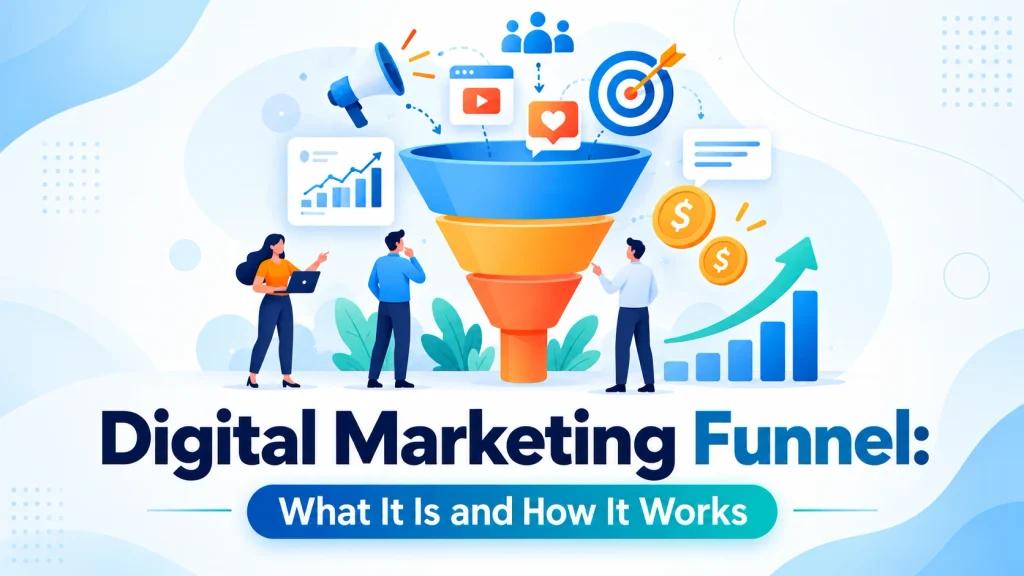
A digital marketing funnel represents the stages people move through when discovering, evaluating, and purchasing from a business through digital channels.
It connects activities such as search engine optimization, social media, advertising, email marketing, landing pages, and customer relationship management into a coordinated process.
The funnel metaphor reflects the fact that not everyone who becomes aware of a business will eventually purchase. Some visitors are researching, others are comparing alternatives, and a smaller group may be ready to act.
However, real customer journeys are rarely perfectly linear. Someone might compare products before subscribing to an email list, leave for several weeks, and return directly to a checkout page.
Therefore, a funnel is a planning and measurement model, not a rigid sequence every customer must follow.
What Are the Main Stages of a Digital Marketing Funnel?
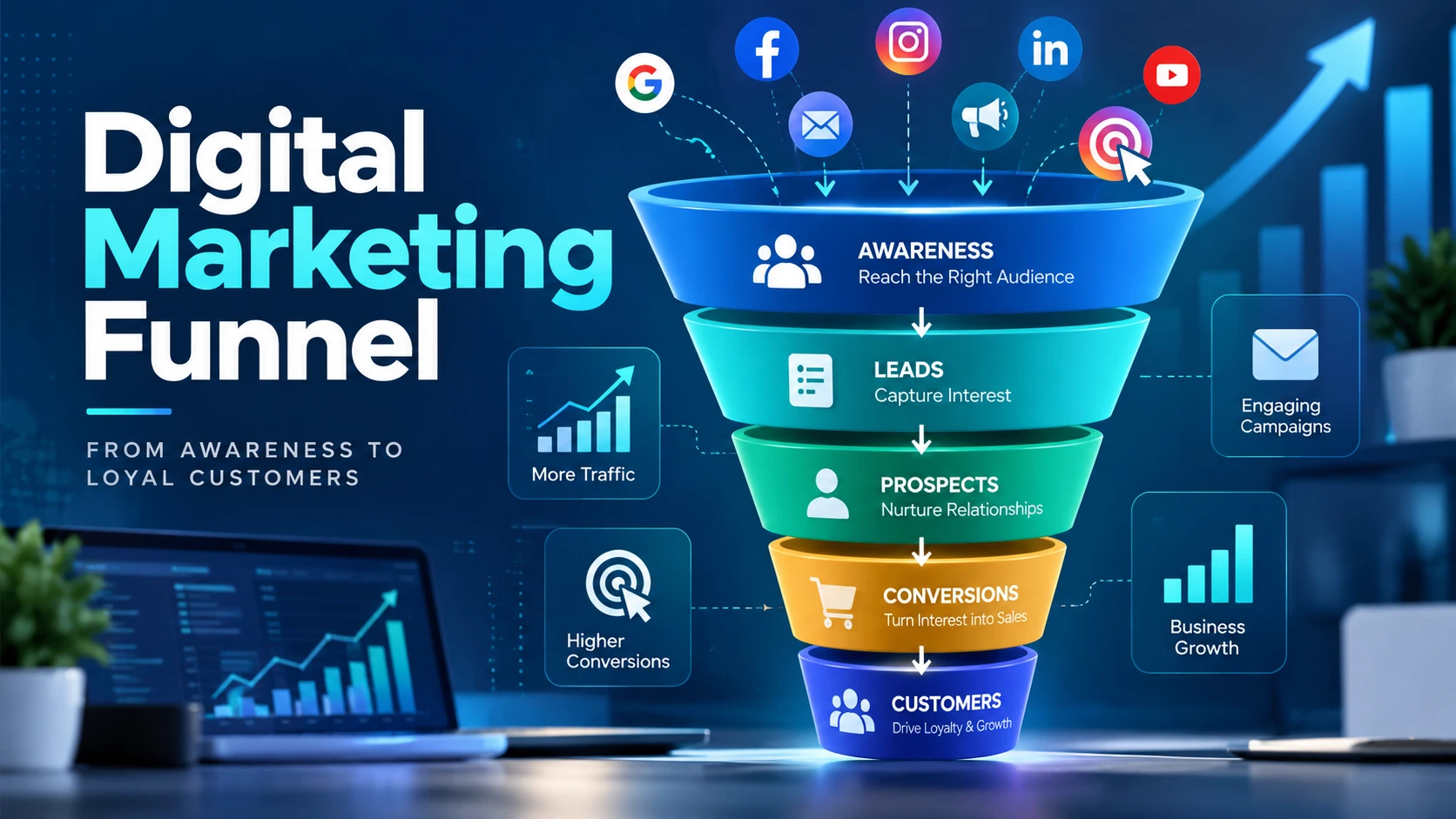
A practical full-funnel model includes awareness, consideration, conversion, and retention. Some businesses separate interest, loyalty, or advocacy into additional stages.
The names matter less than identifying what customers need and which action should happen next.
| Stage | Customer goal | Useful content | Metric |
|---|---|---|---|
| Awareness | Discover a solution | Guides and videos | Relevant visits |
| Consideration | Evaluate options | Comparisons and demos | Qualified inquiries |
| Conversion | Take action | Clear offers and checkout | Purchases or bookings |
| Retention | Receive ongoing value | Onboarding and support | Repeat purchases |
1. Awareness: Help People Discover You
At this stage, potential customers recognize a problem or encounter your business for the first time.
Search-friendly educational articles, helpful videos, relevant social posts, and advertising can introduce solutions without demanding an immediate purchase.
For example, an accounting firm might publish a guide explaining bookkeeping mistakes small businesses should avoid.
The objective is to reach relevant people and establish credibility, not simply generate the largest possible audience.
2. Consideration: Build Understanding and Trust
Prospects now understand their problem and are comparing possible solutions.
Detailed explanations, case studies, demonstrations, transparent pricing information, and honest comparisons help them evaluate fit.
Some visitors may exchange their email addresses for a useful checklist or register for a webinar. Others prefer to continue researching anonymously.
Both behaviors are normal. Avoid treating every visitor who declines a form as an unsuccessful prospect.
3. Conversion: Make the Next Action Easy
Conversion occurs when someone completes a desired action, such as purchasing, booking a consultation, registering, or requesting a quote.
The page should explain the offer, address relevant objections, and provide an unmistakable call to action.
Reduce unnecessary form fields, unexpected costs, confusing navigation, and technical errors. The appropriate amount of information depends on the commitment being requested.
4. Retention: Continue Delivering Value
The funnel should not necessarily end after a transaction.
Helpful onboarding, responsive support, useful follow-up messages, and relevant recommendations can strengthen customer relationships.
For subscription businesses, continued product usage may matter more than another immediate purchase. For ecommerce businesses, repeat orders and customer satisfaction may be more relevant.
How Do You Build a Digital Marketing Funnel Step by Step?
Start with one audience, one offer, and one clearly defined conversion goal. A complicated collection of tools cannot compensate for an unclear customer journey.
- Define the audience. Identify the problem customers want solved, their alternatives, and the questions holding them back. Use customer conversations, support inquiries, and existing search data when available.
- Choose the primary conversion. Decide whether success means a purchase, qualified lead, booked appointment, or another meaningful action. Avoid giving a single page several competing objectives.
- Map the journey. Identify how people discover the offer, what they need before trusting it, and the steps required to act.
- Create an entry point. Use a relevant article, advertisement, social post, or other channel that reaches people with the appropriate intent.
- Build the destination. Create a landing page with a clear promise, supporting details, appropriate evidence, and an easy next action.
- Plan follow-up. Where people have given appropriate permission, provide relevant emails or messages that answer questions and help them decide.
- Connect measurement. Track meaningful actions and test forms, booking links, confirmations, and other essential steps.
- Improve the weakest transition. Review where qualified prospects stop progressing, investigate the cause, and change one meaningful element at a time.
You do not need an expensive technology stack to begin. A functional website, suitable contact-management process, and analytics may be enough for a simple funnel.
Businesses using integrated software can explore our GoHighLevel funnel builder walkthrough for the platform-specific implementation.
Practical Tip
Before spending money on traffic, complete the funnel yourself on a phone. Submit the form, check the confirmation, verify contact records, and test the follow-up. A broken handoff can waste otherwise valuable traffic.
What Does a Digital Marketing Funnel Look Like in Practice?
Consider a hypothetical business offering residential cleaning services.
A homeowner searches for advice on preparing a property for a deep clean and discovers a helpful article. That is the awareness stage.
The article links to a service explanation showing what a deep clean includes, which areas are covered, and how scheduling works. The visitor is now evaluating the service.
After reviewing the information, the homeowner submits a quote request. This becomes a lead conversion, not necessarily a completed sale.
The business responds with a suitable estimate and an appointment option. Once the customer books and receives the service, the business can provide care advice and an optional reminder about future cleaning.
The most valuable lesson is the distinction between capturing a lead and acquiring a customer. Counting quote requests as purchases would make the funnel appear more successful than it actually is.
Which Digital Channels Should You Use?
Select channels according to customer behavior and the role each channel plays. There is no universal requirement to use every platform.
- SEO and content marketing: Useful when customers actively search for problems, explanations, or comparisons.
- Paid search: Useful when identifiable queries show relevant intent and the economics justify advertising costs.
- Social media: Helpful for discovery, education, demonstrations, and ongoing audience engagement.
- Email marketing: Useful for permission-based follow-up, onboarding, and continuing relationships.
- Retargeting: May reconnect with previous visitors, subject to applicable privacy requirements and platform restrictions.
- CRM and automation: Help organize contacts, sales stages, and timely communication across the journey.
Choose one or two acquisition channels initially. Add others when you understand which traffic produces meaningful outcomes.
For an example of connecting contacts, funnels, and automated follow-up in one system, see our explanation of how GoHighLevel works.
How Do You Measure Funnel Performance?
Measure progression between meaningful steps rather than relying only on page views or clicks.
Suppose a hypothetical campaign records 1,000 landing-page visits, 100 completed inquiries, 30 qualified leads, and 10 customers.
The visitor-to-inquiry rate is 10%, the inquiry-to-qualified-lead rate is 30%, and the qualified-lead-to-customer rate is approximately 33.3%.
These figures illustrate the calculation; they are not industry benchmarks.
Useful measurements include:
- Stage conversion rate: People completing the next step divided by people reaching the preceding step.
- Cost per qualified lead: Relevant acquisition spending divided by qualified leads generated.
- Customer acquisition cost: Acquisition costs divided by new customers, with cost categories defined consistently.
- Customer retention: The share of customers who remain active over a defined period.
- Revenue and profitability: Whether the customers acquired justify the costs of acquiring and serving them.
Google Analytics 4 funnel exploration documentation explains how to analyze defined user steps and identify drop-offs.
Remember that analytics events, CRM records, and ad-platform reports may count different things. Establish consistent definitions before comparing results.
Why Do Digital Marketing Funnels Fail?
A weak funnel does not always mean ineffective advertising. The problem may occur anywhere between the initial promise and the final customer experience.
- Traffic without relevant intent: Narrow targeting or change the message to attract suitable visitors.
- Low landing-page engagement: Check whether the page answers the question or promise that brought visitors there.
- High form abandonment: Test technical functionality, field requirements, privacy explanations, and mobile usability.
- Many leads but few customers: Review lead qualification, offer fit, sales responses, and follow-up timing.
- Sales without repeat business: Examine onboarding, product experience, support, and customer expectations.
Do not assume every drop-off is a problem. Someone may decide the offer is unsuitable, lack the budget, or return later. The meaningful question is whether qualified prospects encounter avoidable barriers.
Automation can support the process, but excessive messages or inaccurate segmentation can damage trust. Our beginner’s guide to using GoHighLevel provides more detail on organizing pipelines and follow-up workflows.
How Is Funnel Marketing Changing in 2026?
Artificial intelligence and increasingly connected marketing systems can assist with drafting content, organizing lead information, and personalizing communications.
However, automated content still requires factual review, and AI-generated messages must reflect the business’s actual offer and customer permissions.
Privacy also affects measurement. Consent settings, browser restrictions, and disconnected devices can limit visibility into the complete customer journey.
Use analytics as decision support rather than treating every reported attribution number as absolute truth. Combine behavioral data with qualified-lead feedback and actual business results.
The strongest practical approach remains customer-centered: relevant information, trustworthy claims, clear next actions, and measured improvement.
Frequently Asked Questions
Is a digital marketing funnel the same as a sales funnel?
Not exactly. A digital marketing funnel can cover discovery, education, conversion, and retention, while a sales funnel usually emphasizes the process of turning opportunities into customers. The two often overlap.
Can a small business create a digital marketing funnel for free?
Yes. A small business can begin with existing website pages, organic social content, a contact form, and free or limited-tier tools. Advertising, advanced automation, and software subscriptions may introduce additional costs.
How long does it take to build a marketing funnel?
A basic landing-page and inquiry process may be assembled relatively quickly, but developing a reliable funnel requires planning, testing, and ongoing refinement. Complex integrations and longer customer journeys require more work.
Does every digital marketing funnel need a landing page?
No. A dedicated landing page can help focus visitors on one action, but some journeys use product pages, appointment systems, applications, or existing website content. The destination should support the intended conversion.
What is the difference between a lead magnet and a sales offer?
A lead magnet provides useful value, such as a checklist or guide, often in exchange for contact details. A sales offer asks the customer to make a commercial commitment. A lead magnet is optional, not a requirement for every funnel.
Should you use AI to automate the entire marketing funnel?
AI can assist with content, segmentation, and responses, but complete automation is not always appropriate. Human review remains important for sensitive questions, complex sales decisions, customer complaints, and factual accuracy.
Conclusion
A successful digital marketing funnel is not simply a collection of landing pages, advertisements, and automated messages. It is a coordinated customer journey that connects genuine needs with appropriate information and clear next steps.
Start by defining your audience and desired conversion. Build the simplest journey that supports that goal, track how people progress, and investigate meaningful friction before adding complexity.
As your business grows, improve the funnel through reliable measurement, useful content, thoughtful follow-up, and customer feedback. The objective is not to push everyone toward a sale; it is to help the right customers make confident decisions and receive lasting value.
Related Posts
- What is a sales funnel: The Comprehensive Guide
- Best direct marketing books: You see, books contain countless hours of research
